No part of this book may be reproduced, stored in a retrieval system, or transmitted in any form or by any means—electronic, mechanical, photocopying, recording, or otherwise—without the prior written permission of the publisher, except in the case of brief quotations embodied in critical articles and reviews.
This is a work of fiction. Names, characters, places, and incidents are either the product of the author’s imagination or are used fictitiously. Any resemblance to actual persons, living or dead, events, or locales is entirely coincidental.
This is a preview edition provided for private circulation only.
First digital preview edition, 2025.
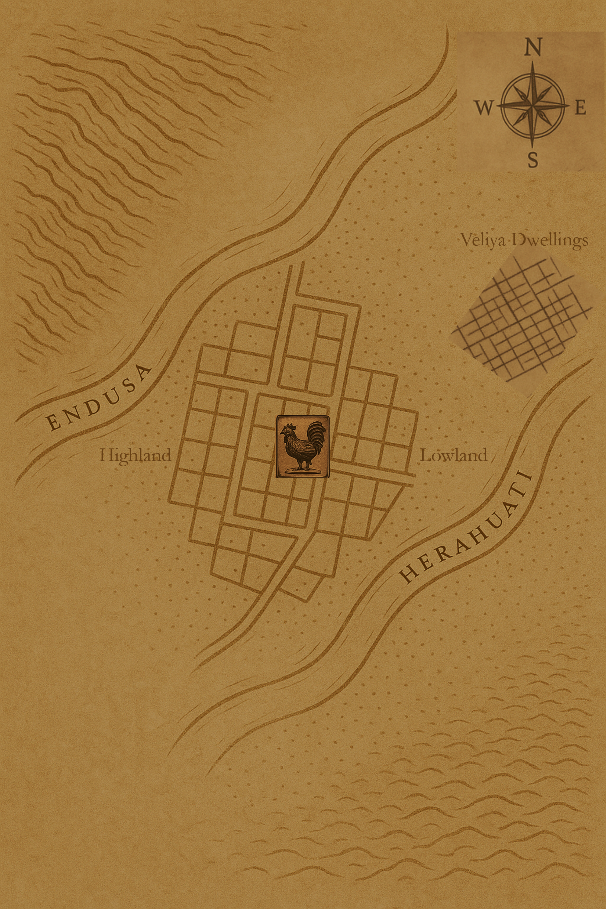
Map of Kukkutur
The city of Kukkutur nestled between the once mighty rivers, Endusa and Herahuati.
“Like a father and mother snuggling a child from both sides, they made the land fertile all year round.”
— Etal
Contents
Chapter One: As the Sun Sets in Kukkutur
Chapter Two: The Children Awaken to Their Destiny
Chapter Three: Of Mysteries and Uncertainties
Chapter Four: Finding Beauty in the Wild
Chapter Five: Leading from the Front
Chapter Six: Fighting Their Demons
Chapter Seven: Being Robbed of Their Childhood
Chapter Eight: Following Light Only to Become the Flame
Chapter Nine: And Kukkutur Gets a New Leader
Chapter Ten: The One Who Treads off the Beaten Path
Chapter Eleven: While Nature Turned the Page
Chapter Twelve: Begetting Dark Times and Darker Deeds
Chapter Thirteen: Until a New Land Emerges
Chapter Fourteen: Beckoning the People Back Home
Chapter Fifteen: To Restore the Lost Glory
Chapter Sixteen: Etching Kukkutur as a Fork on the Road
Prologue
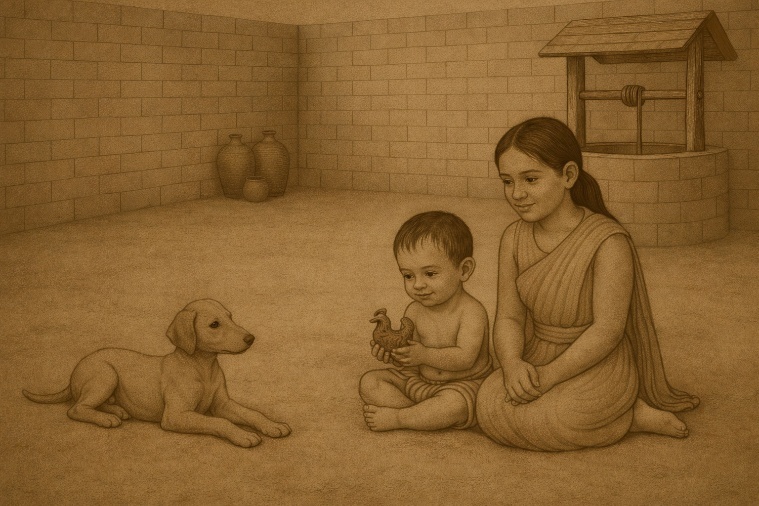
It was a midsummer morning, and the courtyard was warm underfoot, the bricks refusing to let go of the sun’s heat. The little boy sat in a patch of shade, legs splayed, dust clinging to his knees, and turning a small clay toy in his hands—the sculpture of a kuka1.
It was small, fitting neatly into his tiny hands. Its comb was ridged, its beak a neat line, and the soot-dark eyes staring ahead.
“Careful with that, Ehrun,” Hethussu said without looking up. She was busy feeding the stray they had adopted from the streets. He was yet to be named.
“Ku, ku, ku,” Ehrun lifted the kuka to his face and whispered into its beak, as if it could whisper back. Disappointed, he placed it atop a brick and tried to make it walk.
“Don’t make it fall,” Hethussu continued. “Appappa2 won’t be happy!”
The little boy looked up at his mother, confused.
“Ku, ku, ku,” he continued. His vocabulary was limited; he had only just begun to walk.
Hethussu smiled and lifted him into her arms. Ehrun refused to let go of the kuka.
“Let me tell you a story,” she said, carrying him out onto the street and toward the highland gate. The dog trailed behind, wagging its tail.
“Before the walls, before the straight streets, before the river learned our steps,” she whispered into his ear as they walked, “there was only mud and reeds, and a few stubborn people who thought they could live where by the water.”
“The first settlers built with wet clay,” she went on. “They shaped bricks in the sun. They dug channels. They prayed the river would be kind. But kindness is not something you can demand.”
She touched the cockerel’s back with one finger. Ehrun clutched it tighter and pulled it away.
“That year, the rains did not come. The river sank low. The fish vanished. The clay cracked in its molds. People argued. People blamed one another.”
“It all changed one morning,” Hethussu continued, “when the people had nearly given up… a cockerel crowed relentlessly.”
She held Ehrun’s hands and lifted the kuka, as if to make it crow too.
“Not one cockerel,” she corrected, quietly slipping her hand over the kuka. “Many. From every roof, from every alley. Cockerels that had been silent all season cried out together—loud enough to wake even the clouds in the sky.”
“The elders said it was a sign,” Hethussu said. “Not that the drought would end—no. But that people should stop waiting for mercy and start acting like they belonged here. They heard the crowing and remembered their own stubbornness.”
“They dug drains along the streets and deeper wells,” she said, kneeling to draw a line in the dust with her finger, swiftly hiding the kuka in the folds of her sari3.
“They carried water farther. They shared grain instead of hoarding it. They argued less and worked more. And when the first rain finally came—just a sprinkle, nothing grand—the same cockerels crowed again, as if to say: be patient.”
“And patient they were,” she said, lifting him as they neared the gate.
“They worked hard, and the rains and rivers blessed them generously. That is how they built this city of ours—an envy to people from west to east.”
As they stepped outside the highland gate, Hethussu stopped. Ehrun scanned the landscape ahead: rows upon rows of neatly laid streets and houses, bullock carts threading their way through them, markets alive with noise and movement.
Soon, overwhelmed by the sights and sounds, he rested his head against his mother’s bosom. He had forgotten that the kuka was no longer in his hands.
“Kukkutur,” she whispered into his ears. “The city of the cockerel.”
““Ku…,” he mumbled as he drifted to sleep on her shoulder.
“One day,” she said softly, “you’ll tell this story too. And you’ll make it wilder—because that’s what children do.”
CHAPTER ONE
As the Sun Sets in Kukkutur
“Nobody cares anymore. Surely, nobody in your generation,” Etal complained as he stared out of his bedroom window.
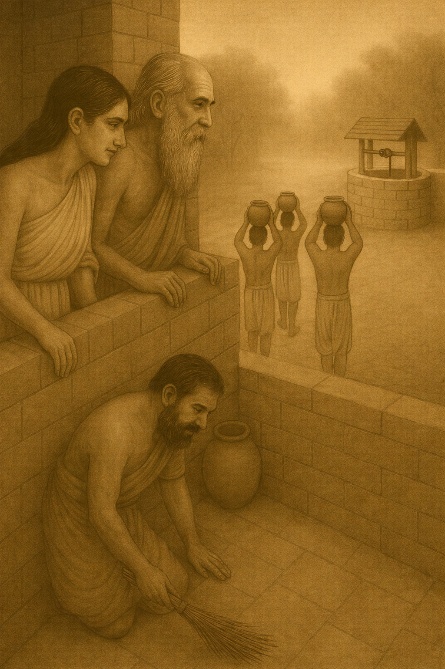
In the dusty courtyard, Ebapu, his son-in-law, had just stepped in with a palm-leaf broom. It was the day before the andu4 celebrations and that called for a spring clean.
He took a long-spouted jar full of water, poured some into his hands carefully and sparingly, and sprinkled it in wide sways across the dry and dusty floor of the courtyard. The chickens and roosters quickly dispersed and perched atop the circular rim of the courtyard well. Their little ones followed them, hurriedly flapping up more dust.
Ignoring Etal’s taunt, Ebapu tied his lungi5 tight and waited for the dust to settle before he started sweeping.
His daughter, Helup, on the other hand, couldn’t help but respond to the old man. In the constantly tilting social balance of their world, most women were increasingly drawing inward. But this young woman was not one to stay silent in the face of unfairness.
She stopped massaging Etal’s feet, looked up at the old man, and scorned, “Does it look like appa6 doesn’t care?”
The silence that followed was as thick as the dusty air around them. Etal lifted his long legs off the floor and stretched onto the bed. The hot afternoon had laid a string of sweat along his wrinkly lip lines. Underneath it, a smile bloomed as he took in a long inhale of the earthy smell that the sprinkled water released from the courtyard.
“There is more to andu than just cleaning up one’s courtyard,” he said as he lifted the edge of his lungi and wiped his face. Taking another deep breath, he reclined back into his bed. The hay in his pillow crumbled as his bony head pressed against it.
“When I was your age, andu was celebrated for days together,” he recounted.
“For weeks, the streets would be bustling with cockerel fights at every corner. Each family—all of us up here in the highland and all of them down there in the lowland—received a bull each to feast and offer.
“On the eve of andu, we dipped in the city pond together—the men, the women, and the others amongst us. The elders then got to cooking feasts and creating kōlam7, trying to outcompete the neighbors in grandeur. In the night, we would all meet by the arena in the lowland and light lamps and sing and dance with one another.
“Do you know that some from the west traveled and came to take part in our celebrations?”
“But didn’t you tell us they have their own andu?” Helup asked. “What is it called?” She tried to remember as she scratched her head.
“Akitu8!” Etal exclaimed. “But despite their festivities, some of them slipped out of their cities and traveled to Kukkutur with our vanijas9. That’s how grandiose our celebrations were! It drew people from far and wide, and we welcomed them and let them stay with us.
“They brought us gifts—bags and bags of beads and jewelry made of carnelian and lapis lazuli.
“But we never accepted them. We had enough of those, and we treat our guests as our own during andu!”
“Yet you couldn’t say no to these gifts!” Helup smiled, looking at the woolen blanket on his bedside.
“I agree, that is one thing we could never resist,” Etal said. “These old bodies needed a respite from the cold nights!”
“Did their women come too? Amma says they have beautiful headgear.” Helup couldn’t contain her curiosity. “I have only seen them in our sculptures.”
“Yes, they did, and they came with their children. We sought blessings from each other’s mothers like we did from our own, and we blessed each other’s children like we did our own.
“And the children! Children everywhere! The cackling of children playing on the streets and going from house to house seeking laddus10. They would even help their elders clean the house and lay kōlam.”
“And now?” Etal was back to his cantankerous self. “Here you are! Bound within these brick walls all day.”
“And your little brother?” He scoffed. “Well, I don’t even want to imagine what he is up to all day with his new Hurrian friends.”
“Whatever he is up to, I’m sure he is having more fun than I am right now,” Helup murmured as she walked out of Etal’s room and looked down into the courtyard from the top of the stairs.
“Appa, can I get another jug of water for you?” she asked Ebapu, who was struggling to keep the dust off his face.
“No, paapa11. We need to save enough for our baths tomorrow morning,” Ebapu said as he stared at the empty well in the courtyard.
“I can go fetch more from the city well,” she exclaimed, looking out to the streets. Men and women were lining up outside the city hall with big pots on their heads and small pouches of grain tucked along their waists.
“They are taxing us only half a pouch of grain for two barrels of water during andu,” she said.
“Haaa, these power-hungry scoundrels! They are now taxing water too!” Etal shouted. “Water! The very water that gives life to our Kukkutur! They stopped the people from using the city pond, and now they are taxing our wells too.
“Well, we should’ve seen that coming from those who worship fire instead of our waters.”
“You can’t blame them for the water receding from our rivers,” Ebapu asserted. “It is the will of Henanna12!”
“It is not the will of Henanna,” Etal argued as he got up and walked out to the terrace.
“It is her curse as she looks down upon us embracing those outsiders and letting them control our lives,” he said, looking out to the busy streets.
Two elderly men waiting in the line turned back toward him, possibly hearing his loud arguments. Etal lowered his glance and quickly climbed down the stairs.
“Appappa13, why are you so embarrassed that we live in a two-storied house!” Helup teased.
Etal ignored her and went toward Ebapu.
“Give me the broom. I’ll sweep the rest.” He reached his hands out.
“No!” Ebapu hid the broom behind him. “I cannot have another night listening to you complaining about your back.”
“Now I have to take your permission to clean my house—”
“Amma!” Helup interrupted the squabble as she ran down to the courtyard and embraced Hethussu, who had just entered the house.
She was carrying a basket on her head and a cotton bag wrapped around her waist, and she looked around the courtyard. Her eyes commanded the family’s attention.
Etal’s diatribe would have to wait.
“I don’t care who sweeps the courtyard, but better do a good job before dawn,” she quipped.
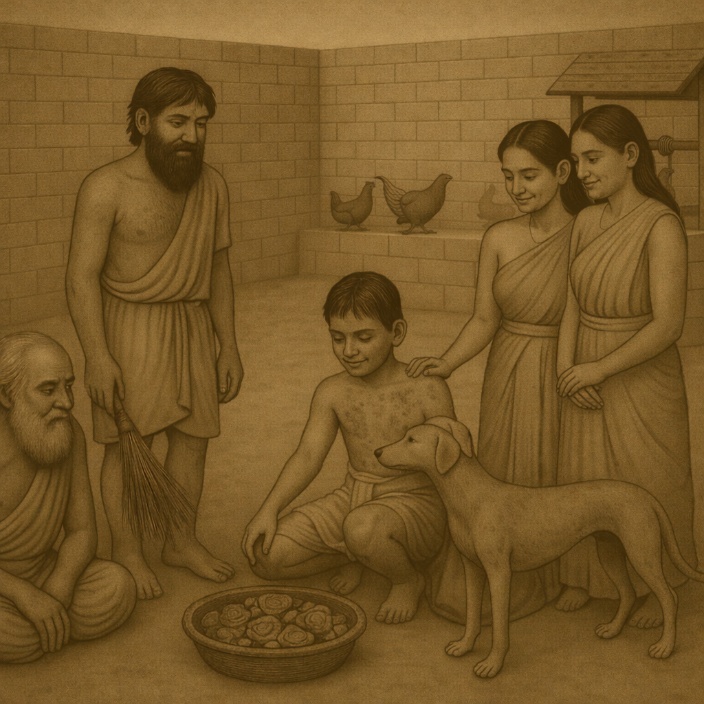
“I’ve brought flowers to make the best kōlam in all of highland this andu.” She beamed in contentment as she took the basket off her head and placed it in the courtyard.
The whole family surrounded it. Etal squatted down to get a closer look, tucking his lungi in.
“These are beautiful, Hethussu. But how did you—”
“Don’t worry, appa. Ebapu and I have been saving some barley every day since winter to buy these flowers. We know how important andu is for you.
“But you forget that it is important for us too,” she asserted with a stern voice.
“Thank you, children.” Etal’s eyes welled up as he looked up at Hethussu before offering a glance of gratitude to Ebapu.
“What’s in that cotton bag, amma?” Helup asked as she rested her head on her mother’s shoulder. She was taller than Hethussu now, but that didn’t stop her from being a child around her.
“Well, do you remember our discussion yesterday?” Hethussu ran her fingers through her daughter’s long, curly hair. “Remember telling me about your favorite dish during andu?
“Buffalo meat?!” She couldn’t contain herself. She knew Ebapu and Etal felt the same way too.
Hethussu opened the bag to reveal two handfuls of cut meat pieces wrapped in peepal leaves.
“But is that all the meat for all six of us?” Helup smiled as she looked at Enbu, the family dog, who had just run in from the streets, kicking dust up along his way.
The chickens flew farther up onto the parapet as Enbu circled around Hethussu and Helup, rubbing his long tail and lanky torso on their saris14.
“Ehrun must be on his way back now,” said Hethussu, rubbing Enbu’s ears. He was more Ehrun’s dog than the family’s and spent all day with him and his friends in the lowland, until it was time to be back home—at which point he raced Ehrun to get home first.
“And the meat? It is plenty,” Hethussu continued as she lifted the meat off the basket before Enbu could put his long, narrow snout into it.
“We won’t have any to offer to Henanna,” she said, looking at Etal. “But she has plenty from the others, and she will understand.”
“Oh, and before you notice, there were no red flowers in the market,” she continued. “The vanijas haven’t found any, and apparently, they are only blooming on the other side of Endusa.”
“But the vanijas go on their boats across Endusa and Herahuati all the time. Don’t they?” Helup looked at Etal quizzically.
“They did, my child. That was before the Hurrians brought the bad luck of this never-ending drought with them. Endusa and Herahuati used to run majestically across our lands.” Etal drifted into nostalgia. “Did you know that long ago Endusa ran on our east, just as Herahuati, and then joined forces downstream and flowed together into the ocean?”
“What? Endusa used to flow on our east? How does it flow on our west now?” Helup wondered.
“The blessings of Henanna! Several andu before, even before we built the highland, she shook the earth to change the course of the rivers. Since then, Endusa started flowing on our west while Herahuati continued on our east close to the lowland.
“Like a father and mother snuggling a child from both sides, they made this land fertile all year round, helping us build our Kukkutur.
“Just like our andu, our rivers too mesmerized those from the west,” he continued. “Vanijas from Uruk would go back with stories of how their Purattu15 and Idiqlat16 dwarfed in front of our rivers.
“And now,” sighed Etal, “they are but a shadow of their past. Especially Endusa. The riverbed is too shallow to sail and too dangerous to swim across.”
“Because of the makaras17?”
“Yes, because they can open their mouths wide and swallow you in one go,” Ebapu mimicked with his hands spread wide at Helup. She was too old for such distractions to lighten the mood, but she played along as she embraced her father.
“Appa, haven’t you told us stories about Endusa drying up in the past and then becoming a fully fertile river again with blessings from Henanna?” Hethussu sat down next to Etal. “Can’t you tell the same to our children? They need hope, not despair.”
“It doesn’t feel the same this time,” Etal sighed. “Yes, Endusa has always changed its course, even gone barren, only to rise back up again. However, every time, we, the people of Kukkutur, have remained the same, patiently waiting for her to return with her blessing. And all along, Herahuati was always abundant.
“Much before even you were born, we pujaras18 used to go up to the banks and measure the water levels against the brick wall. We knew when the floods were imminent and would guide the people to start preparing for directing the waters to the reservoirs in preparation for the sowing season.
“But not this time,” he continued. “With both Endusa and Herahuati flowing weak, the uzhavas19 leaving our cities for the villages, and the Hurrians taking over the highland, Kukkutur is not the same anymore. No one goes to check the water levels anymore.
“We pujaras used to advise the uzhavas to stay patient in these tough times, but the Hurrians are encouraging them to desert the city. They want to turn this place into nothing but a trading hub of vices and high taxes.”
“Well, I’m not sure that will work out well for them,” Ebapu interrupted. “The wealthy among the vanijas are already leaving for Dilmun and Magan20.”
“And why shouldn’t they? Our pujaras argue about curses and blessings while the wells run dry,” Ebapu mumbled. “If Ehrun were to one day leave Kukkutur to make a better life across the oceans, I wouldn’t stop him.”
“Ebapu!” shouted Etal. “Never forget the promise you made to me when Hethussu brought you home!
“Your children will be pujaras and they will lead our peoples just as their ancestors have.”
“But appa, the times have changed and we—”
“I don’t want to be a pujara,” Ehrun interrupted Hethussu as he ran in, panting. “I want to be a nātya21 like Ezra.”
He stood tall and proud as if he just won a game. He clutched a cotton bag across his waist as he gasped for breath. His body was covered up to his neck in marsh. Beads of solidified salt were stuck across his forehead.
“Ehrun! What a mess! We will need the whole family’s bath water just to clean you up!” Helup laughed.
“Why do you want to be like Ezra—”
“Appa, wait!” Hethussu raised her eyebrows. “Ehrun, how did you get this dirty? Where were you all afternoon?”
“I was in the lowland, amma,” Ehrun said promptly. “Ezra and I were playing dice, and then the cockerel fights started. One of the cockerels fled and we all went chasing. I ran very fast and caught the cockerel but fell and rolled over in all the dust and then slipped and fell into the drain.
“That’s how I got this dirty…” Ehrun slowed down his gabble as he looked down at his feet.
“But it was not all for nothing!” He turned his face swiftly to Helup and beamed.
“The vanija, whose cockerel I caught, bought me these red flowers from the market as a gift,” he said as he opened his cotton bag, and there fell a handful of beautiful red hibiscus flowers onto the ground.
“They’re beautiful, right?” He knew that Helup adored these flowers.
The courtyard fell silent. Hethussu went pale, and Etal sat down with his head in his hands. Ebapu swiftly walked across to Ehrun and took his hands in his.
“Paapa, did you go across Endusa?” he asked.
Ehrun was stumped. He thought he had the perfect lie.
“I… I… no, why would I?” he stammered. “I was in the lowland and there was this cockerel fight, and one cockerel fled—”
“Ehrun! Enough! Did you go across Endusa?” Hethussu stared at him with fierce eyes.
“I did, amma,” Ehrun mumbled as he looked down. “But listen, it was only to get the red flowers for Helup. And we all went together—Ezra, Endra, and Emisha too.”
“Endra and Emisha?” Etal shouted. “Those Hurrian kids—”
“Appa, not now!” Hethussu wasn’t done. “Ehrun, why did you lie? Don’t you know there are makaras all over Endusa? Why would you do this?”
“Makaras? No, amma. They only come out at night. During the day they are all sleeping.”
“Who told you this stupidity?”
“Emisha! He said Hurrians go hunting for makaras at night—”
“The Hurrians! They are out to harm our children—” Etal anguished.
“The makaras can kill you—” screamed Hethussu.
“No, amma. Those wide-mouthed ones in Endusa are dangerous,” Helup explained calmly. “The ones in Herahuati have their snouts like our Enbu—long and thin, made for catching fish. That’s all they eat. They won’t harm you.”
“No!” Etal commanded. “You children stay away from the rivers!”
“Did Emisha and Endra go with you too? And Ezra too? I thought he knew better!” Hethussu was still shocked at her child’s misadventure.
“No, they dared me for this top.” Ehrun took out a shiny, intricately designed spinning top—one of the few that were left in Kukkutur, with the increasing migration of kārukas22.
“Ezra said he doesn’t want to swim because his long hair will not dry by sunset,” he continued. “But I know he was lying. He was just scared.”
“No! He is smart. Unlike you! This is your tenth andu and you still act like a child!” Hethussu had had enough. “Go bathe!”
Ehrun ran into the bathroom on his tippy toes and quickly closed the palm-leaf doors.
“Appa, can you pour the water from above like it’s raining?” He stood up on the bathing slab, and called out to Ebapu.
“Well, you know the answer to that!” Ebapu said as he dragged a barrel of water into the bathroom.
“Not after your little misadventure today! Now you’d better hurry up.”
The evenings in Kukkutur offered a brief respite to its hot and dry days. The twilight colors formed a surreal backdrop to the city streets as the temperature dropped. The red-brick walls echoed the chatter of the families huddling in their courtyards. Hethussu’s family also settled into their routine evening chores.
When he was a young man, Etal would walk to the highland gate and stand by the stairs that go to the lowland. He would watch the sunset, casting its hues across the lush green fields and the hordes of uzhavas and vanijas returning home on their bullock carts, some stopping by the streets to join the nātyas in their evening song and dance. Often, he would walk down and join in and have jars of brewed barley with them.
Now, he was an old man walking the highland streets, meeting with his fellow pujaras and learning about the latest atrocities by the Hurrians. He found it less depressing than watching the empty streets of the lowland.
Ehrun and Helup were in the courtyard sitting down to practice their numbers. They raised their left hands and counted out loud as they touched each of the three segments on their four fingers with their thumb. Each time they counted until twelve, they folded a finger on their right hand. They repeated the whole process until they folded all five fingers on their right hand, counting to sixty.
Ehrun would get bored between each round and excuse himself to practice his acrobatics—doing cartwheels and somersaults.
Back in the kitchen, Ebapu and Hethussu were busy cooking dinner. Tonight was special—along with the barley porridge, they were cooking buffalo-and-lentil stew. Enbu was lying down outside the kitchen—his body half in and half out. With his head between his paws, he kept his eyes gently closed to ignore Hethussu, who constantly asked him to keep away.
Enbu wasn’t the only one struggling to do so. Ehrun and Helup were distracted by the aroma from the freshly ground spices—constantly messing up their counting.
“I could smell it from two streets away,” Etal whispered loudly as he walked into the courtyard.
The spices were once a mark of elegance and the aroma a mark of the family’s abundance. Now, it cast a sense of embarrassment for indulging in vices during these times of hardship—just as living in two-storied houses did.
The family quickly sat down in a circle as Ebapu placed the pot of stew and a plate of porridge between them. Hethussu closed her eyes lightly to pray to Henanna and thank their ancestors. From the corner of her eyes, she could see Helup and Ehrun already licking their fingers after their first bite. Ehrun was spinning the top with his other hand.
She didn’t have the energy to reprimand them any further. But Etal did.
“Ehrun! In another four andu, you will be making your first travel to the west. It will also be the Perandu23, and you will be competing in your first kaalai-taluvu24—”
“And appa has been teaching me how to tame the bull and all the acrobatic tricks! Shall I show you?”
“That’s not the point,” Etal reprimanded him. “You need to stop acting like a child! Do you know what Ebilgames told me out on the streets?”
“Ebilgames was allowed in the highland at this time?” Hethussu was surprised.
Kārukas like Ebilgames lived in the lowland, along with the uzhavas, nātyas, and vanijas. Only those born as pujaras were allowed to live in the highland. Those from the lowland, such as Ebapu, who started living with a pujara, were also allowed to live in the highland. While the rest of the people of the lowland were not allowed to live in the highland, they were always allowed to visit freely. The aresis25 have now restricted their access only during the daytime.
“He was called to bring a new spinning top for Endra. Apparently, the kid lost the top he had.” Etal stared at Ehrun, who kept his head down and hid the top behind him.
“Ebilgames said that the Hurrians have been buying spinning tops and other toys from kārukas like him in bulk. They are enticing pujara children with it and abducting them—”
“Appa, that’s enough! Don’t tell the children these horrible rumors. For good or bad, our Kukkutur is changing, and the children must learn to live together. Don’t create enmity in their minds!”
“I’m creating enmity? Your sister left because of the enmity these Hurrians created, and you say I’m—”
“Appa, not in front of food. And not in front of the children,” Hethussu reprimanded him.
The family finished the rest of their dinner in silence. While no words were spoken, turbulent thoughts ran through their minds. They each had their demons to deal with.
Etal was struggling to cope with the rapid erosion of the culture that he grew up in. They didn’t have a lugal26, unlike the westerners. They believed in the will of the people enforced through the pujaras. It wasn’t perfect, but they lived together in peace, sharing resources equitably. Ever since the Hurrians arrived, they had been limiting the powers of the pujaras in an attempt led by the aresis to crown one of their own as Kukkutur’s lugal.
Hethussu had her internal struggles too. She was yet to cope with the departure of her sister, Hedumbi. Despite several andus that had passed, Hethussu and Ebapu had spent every day in a dilemma—do they stay and protect their family’s legacy, or do they accept their looming irrelevance in this changing Kukkutur and leave themselves?
Hedumbi’s departure and the changing social norms in Kukkutur had a huge impact on the girls and women. Helup was no exception. Her world was now largely confined to the courtyard of their house. In the Kukkutur of the past, she would be in the city hall with the other pujara women, debating and attesting the rules for the people. Instead, here she was seeking comfort in the safety of her family. Etal’s constant reminder of her fragility made it worse.
And finally, Ehrun. One would think he was drowning in the shame of his lies being caught and the fear of the danger he put himself in. But he had bigger questions to ponder.
“What do the Hurrians want? Who are they? Why does amma always stop appappa from talking about them?” he thought as he looked up at Etal.
“I know how to get the answers!” He smirked as he licked his fingers clean.
As the family retired into their rooms to sleep, Etal took his jute mat and laid it out in the courtyard. On the days leading up to andu, and for days after, he loved lying down in the courtyard, staring up at the clear sky, admiring the stars and all the constellations.
As he was about to slip into a slumber, he felt a warm pair of hands on his feet.
“Appappa, I heard that you didn’t get your legs massaged properly today,” Ehrun said, hovering over him.
“Well, who told you that?”
“I did!” squealed Helup as she uncovered herself from behind Ehrun.
“Come here, you little piglets!” Etal held them both in his arms as they snuggled in on either side of him, resting their heads on his shoulders.
“Appappa, why don’t you like me playing with Hurrians?” Ehrun prodded, knowing well that his question would open the floodgates.
“Hmmm, you wouldn’t want to play with them if you knew who they are,” Etal said.
“Endra told me they are not Hurrians,” Ehrun said. “He said that is just a name we pujaras gave them. Just like they call us all mleccha27!”
“Then why don’t they tell us who they are? Have you asked him that?”
Ehrun looked down, perplexed.
“Of course they won’t tell us that. They don’t want us to know who they are or where they came from,” Helup added.
“Why? What do they fear? Did they do something bad?” Ehrun prodded.
“Yes, and we know all about it. Thanks to all the vanijas who have heard stories about them during their travels to the west,” Etal said.
“Tell me, appappa. I want to know who they are. I want to know why you think they tried to hurt me.”
“We will never let them hurt you, my child,” Etal said, holding him closer.
“Let me tell you what we know. But remember, there’s so much we don’t know.”
Ehrun turned toward Etal, his pupils opening wide with curiosity but also struggling to see Etal’s face in the dark.
The old man took a deep breath and started narrating the story.
“In a land far, far west, there was an empire called Mitanni ruled by a cruel and evil regime, the Hurrians. They imprisoned and killed the followers of Henanna and only worshipped fire. Lugals from empires around them, who were followers of Henanna, convened and sent messages to the Hurrians to engage and negotiate. All those attempts failed. They could never understand what the Hurrians wanted.
“Bizarrely, the Hurrians never laid their thoughts on clay or metal or any matter. They passed their thoughts to their children by whispering them into their ears.”
“Why? What did they tell them?” Ehrun’s curiosity ran high.
“We will never know. How can one ever trust those who don’t lay their thoughts down!” Etal anguished.
“Anyway, after years of their tyranny in Mitanni, a new lugal, Ahsura, rose to power in a neighboring land. He was more evil than the Hurrians and defeated and exiled them.”
“And they came to Kukkutur?”
“Yes, at first a few. They were all aresis. They were all men. Some of our pujaras welcomed them, and their daughters lived with them.
“Then came another wave of them. And then some more. Again, they were all aresis. They were all men.”
“But Endra is not an aresi. He said his father is a lugal. And he said he will be one too,” Ehrun parroted the stories he had heard. “He says he is named after the god of rain and thunder. If he becomes lugal, then our rivers will start flowing again.”
“They said so about his father Dyaus too. They told us that if we let them worship fire and crown him as our lugal, Kukkutur will go back to its past glory,” Helup said.
“We didn’t. And we never will,” Etal asserted. “We have insulted Henanna by welcoming her enemies. Until we rid Kukkutur of these outsiders, Endusa and Herahuati will not flow again.”
Ehrun and Helup looked down in despair. These stories were always too intense for the young.
“Children, do you know Henanna watches over us all day and all night?” Etal tried to distract them.
“Even when you are playing with the Hurrians!” He couldn’t help planting some fear in them.
“Yes, from up in the sky, right?” Helup mumbled as she yawned. She had heard stories after stories of Henanna as a child.
“Then why can’t we see her?” Ehrun asked.
“Well, she can’t be seen with our open eyes,” Etal explained. “But we can see her with our eyes closed. Haven’t you seen your amma meditate and pray to her?”
“Hmmm, OK.” Ehrun wasn’t happy.
“But you can see her little helper in the sky.”
“Where?” screamed Ehrun.
“Shhh, don’t wake up your sister,” Etal said, pointing to Helup, who was already asleep. “There! Do you see those stars come together like a deer?” He smiled as he pointed at the sky.
“Yes, but it has a horn!”
“Yes, a single horn! Otraikompan28! He takes her around Kukkutur to take care of all of us.”
Ehrun raised his head in an iffy and stared down at Etal’s neck.
“Appappa, is it what you have on your neck?” Ehrun pointed at the seal pendant on Etal’s chest, looped around his neck with a thick gold thread.
Etal pulled Ehrun back into his embrace.
“Yes, Otraikompan. Our ancestors have held this seal for generations, attesting all the trade and all the laws of our land. Those of us who hold this seal are destined to lead the people of Kukkutur.
“And one day that will be you. You do know that, right?”
Ehrun was fast asleep.
CHAPTER TWO
The Children Awaken to Their Destiny
The sun shone hot and bright that morning in Kukkutur, making the red-brick walls along the streets burn in its heat.
In the lowland, the people were receding back to their regular lives after a week of andu celebrations. The uzhavas sat around the arena as they strategized their plans to till the lands for the summer. The vanijas met with their counterparts from the villages in the east who brought their goods to the marketplace. Together, they would sell to the visiting westerners. At the end of summer, they would travel with the leftover goods to the markets in the west.
The nātyas had pitched tents around the market and performed songs, dance, and drama for the visitors in exchange for goods. The kārukas sat behind their trading desks and took orders for jewelry, cookware, toys, and a wide range of crafts.
The cockerel-shaped whistle was in highest demand. It was a mascot of Kukkutur—the land of the cockerels.
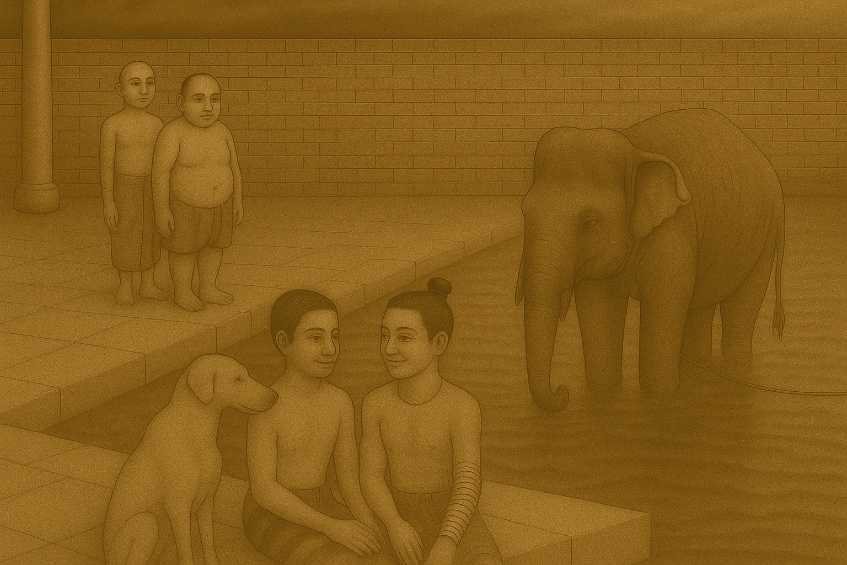
In the highland, the pujaras and aresis met in the city hall to discuss the taxes for the upcoming farming and trade season. Across the pillars of the hall, far in the background, Ehrun and Enbu sat alone by the city pond. Well, almost alone.
On the other end of the pond was the once-majestic Arikompan29, the elephant that the pujaras had received from the vanijas of the south in exchange for allowing them to sell rice in Kukkutur. He grew up in Kukkutur as a symbol of the city’s prosperity and the pujaras’ sway over the people.
But as everything else that once stood mighty in Kukkutur, he too had weakened in stature. His skin drooped. His ribs protruded.
As he stood poignantly drinking water from the pond, on the other end, Ehrun dipped his feet in the water as he sat lost in thought. While the world of Kukkutur went back to the familiar, his world had troublingly changed over the last few days.
“Why didn’t the Hurrians join us in the andu celebrations? Endra and Emisha were nowhere to be seen!
“Did they really trick me into going into Endusa? Did they try to kill me? Did they—”
“Guess who I am!” Ehrun was interrupted by a voice as a dark, slender hand came from behind and covered his eyes.
“Stop it, Ezra!” Ehrun said as he pushed the hand away.
“How did you know that was me? I thought I did a great job imitating Endra’s voice.”
“I could smell that butter on your fingers!” Ehrun said, looking at the small pot of butter in Ezra’s hands. It was his favorite snack.
“And I could hear your bangles from a distance,” he continued. “Even before you spoke!
“You now have bangles on your right hand too?” he asked, almost disinterested.
“Hmmm, someone seems upset. Did Hethussu ask you to clean your room today?” Ezra asked as he admired the bangles on his hands and took another fingerful of the butter to eat.
“Ezra, why didn’t you go into Endusa with me that day?” Ehrun looked into the waters as he pondered.
“Because I didn’t want to die. I told you they were lying. The makaras are dangerous—day or night!”
“Then why didn’t you stop me?”
“I did! And you called me a coward and went anyway.
“Oh… you called me a coward. I had forgotten! I should be the one mad at you.” Ezra laughed as he pulled his long hair up and tied it into a bun with a jute rope.
“Etal says the Hurrians are evil. They hate us followers of Henanna,” Ehrun said.
“Yes, yet they had to name their children like us. Dyaus never changed his Hurrian name. He started living with a pujara and changed her name to Prthvi,” Ezra said. “None of the aresis changed their names either. They all made their pujara women change their names.
“But look at how they named their children. Look at Emisha. Look at Endra,” he continued. “They want to be like us. They want to name their children like us. Yet they can’t stand us or our customs. Or our—”
“Ezra, you look like a beautiful girl with the bangles!” Endra jeered as he ran toward them. Emisha was right behind, huffing and puffing and swiping the sweat off his shaved head.
“No, he is a boy! Stop making fun of him,” Ehrun retorted. Ezra remained silent and looked down at his own reflection in the pond, as if in a trance.
“Boys don’t wear bangles!” Emisha joined in.
“They do!” Ehrun retorted.
“Dyaus-pitr30 told me how all the boys and men in Kukkutur, with all your bangles and jewelry, are like those colorful chickens in the market,” Endra continued to provoke. “It is your daughters and mothers who act like cockerels!”
“I don’t understand the joke or the insult, Endra.” Ehrun stared into Endra’s blue eyes. “But I know that friends don’t behave like this. Surely, they don’t try to kill each other.”
“Kill who?”
“Me! You lied that there are no makaras in Endusa during the day!”
“There aren’t! They only come out at night. That’s when Endra goes to catch them with Dyaus-pitr,” Emisha said.
“What?!” The absurdity of what Emisha said shook Ezra out of his trance.
“Yes, baby makaras are the aswa’s favorite food. Endra catches one every night and brings it home to his aswa!”
“Aswa?” Ehrun and Ezra exclaimed in unison. They were getting increasingly confused by Emisha’s story.
“You carve our aswa on your seals and yet you don’t know about it?” Endra mocked them. “Your people believe that Henanna travels on the aswa but he is in my courtyard!”
“Otraikompan?”
“Ha, see, Endra,” Emisha continued his diatribe, “when their ancestors first saw our aswa and its divine beauty, they were so mesmerized that they went back to Kukkutur and made these seals to look like it. Now they call it otrai… otraiko…
“Ugh! You can call it whatever you want in your mleccha language. You can hold those poorly carved seals but the real aswa is divine and immortal and lives with us. Passed down from generation to generation, it is with Dyaus now, and soon it will be with its rightful owner—Endra!
“And you know what they say? The one who holds the aswa leads the people of the land,” Emisha said, patting Endra’s shoulders.
“You are liars! One lie to cover up another lie!” Ehrun screamed as he walked out, holding Ezra’s hand.
Endra and Emisha turned away defiantly and went to the elders in the city hall.
Arikompan dipped his trunk again in the shallow waters of the pond, sending ripples through the reflections of Ehrun and Endra walking away from each other.
“Baby makaras! Aswas!” Ehrun mumbled as he walked back and forth in his courtyard. Enbu ran around him, wagging his tail playfully, clearly mistaking the mood in the air.
“I don’t understand them. I don’t trust them.”
“You know who can tell us more about them?” Ezra whispered as he tried to keep pace. “Ebilgames! His ancestors spent their lives traveling to the west and they knew everything about the Hurrians.”
“Yes, let’s go! I don’t want to sit around and let them humiliate us.”
“Yes, and Ebilgames must be waiting for me,” Ezra continued. “Remember? I had paid him to make a sculpture of me. He said it will be ready today.”
“Of course, we remember! That is all you have told us about for days together now,” Helup joked as she walked into the courtyard. “And I am sure he will make you look beautiful. You are indeed the most beautiful of Ehrun’s friends.”
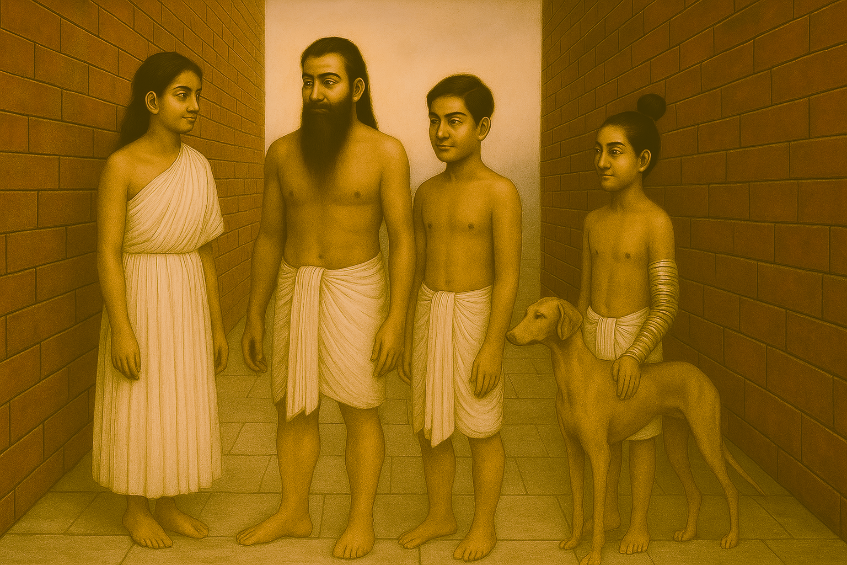
“Helup! See, I got these new bangles!” Ezra raised his right hand.
“They’re beautiful! You remind me so much of Henkidu.”
“Henkidu? Who is that?” Ehrun asked.
“You don’t know Henkidu? And you’re going to meet Ebilgames?” Helup rolled her eyes.
“Actually, I don’t know her either,” Ezra said sheepishly.
“Hmmm, it is a sad story. One of love, jealousy, and heartbreak.” Helup settled down next to Ezra and stretched her legs. “But I’m not sure I have the energy to narrate a long story now.”
As if on cue, Ehrun sat down next to her and started massaging her feet.
“Tell us!” he begged. “Please!”
“Fine!” Helup said. “Just don’t stop massaging!”
“Yes!” Ehrun got impatient. “Now tell!”
“So a long time ago, much before I was born, Ebilgames was born to a family of kārukas in the lowland,” Helup said.
“Yes, we know that,” Ezra said.
“Do you want me to tell the story or no?”
“Sorry! Please tell us.” Ezra covered his lips with his fingers.
“Hmmm.” Helup continued. “After every andu, his family travelled to the west with the vanijas in search of new markets for their craft.
“His friend Heshtar was a pujara who lived amongst us. They were inseparable. When his family travelled, Heshtar’s family let him stay with them. I remember them playing on these streets when I was little.”
“A kāruka staying over in the highland after sunset?” Ehrun was bewildered.
“Remember, this was before the aresis took control of the highland.” Helup said. “Back then the people of the lowland and the highland roamed about freely.”
“I wish I could do that now,” Ezra muttered.
“Now will you let me continue the story about Henkidu?” Helup brushed Ezra’s hair.
“Yes, tell us!”
“After Ebilgames’ fourteenth andu31, his family took him along on their travel for the very first time. Heshtar sorely missed him. She vowed to her family that she would invite him to live with her the day he returned.
“As fate would have it, Ebilgames met a travel companion on his way to the west. He was mesmerized by her.”
“Henkidu?” Ezra gushed.
“Yes, she was just like you!” Helup said.
“Why, was she an orphan too?” Ezra asked.
“You would be surprised,” Helup said. “She was indeed.
“But that is not why I said she was like you. She was beautiful like you. Bangles adorned her hands, and she tied her hair with a gold thread just like you do.
“Ebilgames was intrigued by the melancholy in her eyes. They spent days traveling together and shared stories of their worlds. He learned that when Henkidu was a child, her village had a mysterious disease that took the lives of many, including her whole family.
“Finally, when it was time for Ebilgames to return to Kukkutur, he asked Henkidu to join him and start living with him. As a loner, it wasn’t a difficult decision for her. It also helped that Ebilgames and his family gave her a sense of belonging she had long lost. She returned with him and soon became one of Kukkutur.
“And what about Heshtar?” Ehrun asked.
“She was heartbroken, but soon she met an aresi who invited her to live with him. Do you know who it was?” Helup asked.
Ezra and Ehrun looked at each other, bewildered.
“It was Emisha’s uncle. His appa’s brother.”
“I have never seen his father, let alone his uncle!” Ehrun said.
“Wait, this is such a beautiful story,” Ezra remarked. “Why did you say it is sad?”
“Because the peace didn’t last long,” Helup continued. “Much to Heshtar’s chagrin, Ebilgames and Henkidu became the epitome of happiness in Kukkutur. Her jealousy got the better of her.
“One day, she complained that her golden waist thread was missing. Everyone in Kukkutur got together to search for it, for this was the first time anything of value had gone missing from the highland. They went from house to house and finally found the thread in Ebilgames’ house, tucked in one of Henkidu’s lungis.
“Henkidu was punished to go into exile. She claimed that she didn’t do it. Ebilgames went to Heshtar and pleaded.
“‘Please, Heshtar. Forgive her! Forgive her on my behalf!"
“‘I will. Will you live with me then? Henkidu can never give you children. She wasn’t born a girl like me.”
Ezra’s face dropped as those words fell out of Helup’s mouth. Ehrun was shocked, and yet not. It all made sense to him. He came close to Ezra.
“Now you will also make fun of me like Endra and Emisha do!” Ezra said. Her eyes welled up.
“I would never—”
“Helup, you always knew? Didn’t you?” Ezra asked.
Helup smiled in response—a smile that sent a wave of tranquility through Ezra’s racing heart.
“And then what happened to Henkidu?” Ezra abruptly tried to get back to the story.
“Ebilgames couldn’t save her. Nobody could. This was a crime against the pujaras. And that too by a westerner.” Helup sighed as she took a long pause.
“Years later, Heshtar caught the same disease that took the lives of Henkidu’s family. She coughed constantly, struggled to breathe, and her neck swelled like a clay pot,” she continued. “On her deathbed, she called for Ebilgames. He stood outside the courtyard as she spoke to him from her room. She confessed that it was she who put the gold waist thread in Henkidu’s clothes. She begged for his forgiveness.”
“What a wretch! How could she ask for forgiveness?” Ehrun groaned.
“Love does create devils. I don’t know whether Ebilgames ever forgave her. But he surely never forgot Henkidu.” Helup continued. “After every andu, he still travels to the west to sell his crafts. He spends less time selling and more looking for her in every crowd. Hoping one day he will meet her again.”
“I believe he is traveling again soon. You better hurry up!” she said.
Ehrun and Ezra gathered themselves, determined to learn all about the Hurrians from Ebilgames, whom they now had a newfound respect for. As they walked out of the courtyard, Ehrun turned around.
“Helup, why don’t you join us?”
The trio walked down the dusty streets of the lowland. Enbu led the pack as always. The veliyas32 were busy draining the sewer sumps. They used to sprinkle water and clean the streets of the lowland, but with water being increasingly scarce, they had been instructed to clean only the streets of the highland.
Enbu led them through the streets where all the uzhavas lived. There were very few of them left; most had migrated east. The wide streets that were once filled with bullock carts going in both directions were now a playground for children. Families of vanijas, kārukas, and nātyas continued to move into empty houses left behind by the uzhavas. These houses weren’t very different from those in the highland, yet the walls had a stark difference. They were made of mud bricks with rough edges—quite unlike the highland where red fire-baked bricks were used, especially adorning the outer walls of the houses.
The trio walked past a bunch of uzhavas and bowed to them. The uzhavas who had stayed back were revered for their loyalty to Kukkutur and Henanna, although most believed that it was just a matter of time before they too would have to migrate to the east.
They acknowledged the visitors from the highland and continued sorting the winter produce from their small farms. Large bags of grains, vegetables, and fruits were set aside to sell in the lowland marketplace, and small bags of spices and large baskets of live chicken to send with the vanijas to the west.
Ehrun and Ezra jumped onto a bullock cart that was headed to where Ebilgames lived. Enbu and Helup chased behind them. As they turned onto a narrow street, the cart stopped. There wasn’t enough space to walk, let alone for a bullock cart to pass through.
The place was bustling with activity. The kārukas and uzhavas were bringing their goods to be sold in the west, and the pujaras were stamping seals for each bag—attesting their origin in Kukkutur, their ownership, and what they could be bartered for. Bags of grains were kept aside to pay taxes to the highland in lieu of the stamping.
Across the corner, a family made bread in their courtyard to sell to the visiting crowd through a small window on their wall.
“One pouch of barley for two breads!” someone shouted from inside.
Meanwhile, the vanijas were busy negotiating their own fees for transportation while preparing small bags of dried fruits and dried fish for their travels.
“Why aren’t any aresis here?” Ehrun wondered aloud as he looked around. “We pujaras get our grains for stamping seals for the merchandise. How do they get their food?”
“By doing nothing!” Helup said with contempt.
“They get a share of the taxes paid to the highland. Just because they live with the pujaras!”
“They get a share of taxes for doing nothing?”
“Yes, they say if the pujaras are paid for praying to Henanna for Kukkutur’s prosperity and the safe travels of the vanijas, then they are owed taxes too for praying to their god, Egni33.”
“But they don’t even come down to stamp the seals!”
“No, they don’t. Because they don’t want to ‘pollute’ their bodies by mingling with the ‘mlecchas’ of the lowland.”
“But they sure come around for alms after every harvest!” Ezra scorned. “Guess we don’t pollute them then!”
“Every day I learn something new and atrocious about them!” Ehrun mumbled as he picked up pace. He couldn’t wait to reach Ebilgames’ house and learn more about the Hurrians.
“This way, friends.” Ezra guided them to a house at the end of the street. As they reached the entrance, a little boy peeked out of the courtyard.
“Appa, there are some people here to see you...!” His voice faded as he swiftly ran back into the house.
Ebilgames walked out onto the street. Standing only as tall as six bricks stacked along their length34, he was shorter than most men in Kukkutur. Despite that, he looked imposing with his untied curly hair and long beard down to his navel, braided halfway from left to right.
“Ezra, I have been waiting for you. And Helup and Ehrun? What brings you to the lowland?” Ebilgames asked as he showed them into his courtyard.
“We want to know about the Hurrians. Everything you know about them!” Ezra said.
Ebilgames sat down in the courtyard and continued braiding his beard.
“All of you want to know? Or just this curious grandchild of Etal?” He smiled, looking at Ehrun from the corner of his eyes.
Ehrun was still intimidated and puzzled. “This burly man is the hero of Helup’s love story?” he wondered.
Ezra took the lead in presenting the trio’s predicament, narrating all the rumors they had heard about the Hurrians—from their exile from Mitanni to their atrocities against the followers of Henanna. Including what they had just heard that morning from Emisha—Endra’s aswa that supposedly eats baby makaras!
“Well, you seem to know everything already! Almost everything!”
“So Endra’s aswa is our Otraikompan?” Ezra asked. “It eats baby makaras? How did he get—”
“And if they have Otraikompan, then they will lead Kukkutur? Not us pujaras?” Ehrun interrupted.
“Haha, so that’s what’s bothering you, little pujara? Ebilgames jibed. “To cede the power to the Hurrians?”
“No! I mean, yes, that too.” Ehrun stumbled. “Doesn’t it bother you? To be led by the Hurrians?”
“Because being led by you pujaras has been great for us?” Ebilgames scorned as he looked away at the peepal tree in his courtyard.
Tied to it was a lungi—the one in which they had found the allegedly stolen gold waist thread. Fresh flowers were laid immaculately under it. The man had created a shrine for Henkidu.
“Did you see the condition of our streets in the lowland?” Ebilgames turned back to Ehrun. “They didn’t clean it even for andu! When the aresis restricted the use of water, the pujaras negotiated for the highland to still be cleaned. What about us? They didn’t fight for us. Do you call that leading?
“We are not allowed to float the bodies of our dead into the samudra35. Only the pujaras can,” he continued. “While we bury ours in our lands, hoping our dead will be reborn as a pujara. The only way to earn some respect here.
“Aren’t we children of Henanna too?” Ebilgames asked Ehrun what Ezra never could.
Ehrun looked down and didn’t utter a word.
“I didn’t mean to bring you more despair.” He sensed the guilt in Ehrun’s eyes. “Of course, despite all that I said, I would rather you pujaras lead us. I would rather not be called mlecchas.
“You have taught us and our children to lay our thoughts on clay, to recite prayers to Henanna, to count our seals, to measure our bricks, and together we celebrated our mothers.
“And here they are—unwilling to put their own thoughts on clay, whispering their prayers only into the ears of their children, keeping us away from the highland, and disrespecting our women.
“And that’s when they are sober. Once they have had their haoma, it’s a whole other—”
“Haoma?” Ehrun asked.
“An intoxicant the Hurrians drink and let the worst of themselves come out. And that is all we know. We haven’t ever seen it, let alone drunk it. Just as we have never seen Dyaus’s aswa,” Ebilgames said. “They brought it to Kukkutur on the darkest nights, covered in drapes. They told us it’s their divine animal. They said that it will bring bad luck to anyone other than the Hurrians who sees it.
“And now their children are saying that the animal is Otraikompan? Those who killed the followers of Henanna are worshipping Otraikompan? They must take us for fools!”
“See, I told you! Yet another lie!” Ehrun told Ezra. “They want to trick us into accepting them as the leaders of Kukkutur.”
“And trickery is what they do! After every andu, when we sail to Akkad, we would dock at Dilmun first and then Magan.” Ebilgames narrated. “In between, more often than we would like, we would lose our way in the sea and the disha-kakas36 would take us to the nearest land. It is during those times that we heard stories from the locals about their encounters with the Hurrians.”
“What did you hear?” Ehrun asked.
“After the Hurrians were exiled from Mitanni, they travelled east to small kingdoms whose lugals were old. They befriended them and enticed them to games of pakitai37,” Ebilgames said. “They then got the lugals intoxicated on haoma, enticed them into gambling their lands, and then won the game—and their lands—by cheating.
“But it all stopped with Kukkutur,” he continued. “They saw a land like no other. A land and its people so vibrant like no other. Yet, there were no lugals. The pujaras couldn’t be enticed with haoma and neither did they own the lands to gamble away.
“So, they decided to live with the pujaras and slowly change our lives and our Kukkutur.”
“Why did the pujaras let them into the highland?” Ezra asked.
“There is no limit to what some of us can do when offered gold,” Helup said. “And even more valuable than gold? Ego.
“The aresis made the pujaras feel like they are the chosen ones. They lived with them and instilled in them a sense of doubt and enmity toward the rest of the people of Kukkutur.”
“You are a wise woman, Helup. Just like your mother and your aunt!” Ebilgames said. “The aresis indeed tricked us into hating each other. Do you know who hid Heshtar’s gold thread in Henkidu’s clothes? Your friend Emisha’s father! That was the last thing Heshtar told me.”
“That’s just like Emisha. So deceitful!” Ehrun said.
“Yes!” Ebilgames asserted. “A few days later he was found dead in the city pond.
“No one ever knew how. Not a single soul knew,” Ebilgames said as he covered a contented smile and stared at Henkidu’s shrine.
Blood drained from the faces of the boys. They struggled to reconcile the romantic hero of the story they heard earlier that day with the person in front of them.
“Must’ve drowned in his misery.” Ebilgames chuckled to make light of the situation.
“Maybe love does create devils,” Ehrun wondered.
“Ebilgames, can I get my sculpture now?” Ezra tried to break the awkward silence.
“Of course! Paapa! Get the sculpture from my room!” Ebilgames called out to the child peeking out of his bedroom window.
“Who is he? I didn’t know you had a child!” Helup said.
“He is Essarukin,” Ebilgames said, “he wasn’t born to me but he is my child. His parents were veliyas and his mother passed away giving birth to him. His father passed away last andu, drowning in a sewer sump. The family soon sold him to a vanija from the west.”
“No!” Ezra gasped. The pain of being orphaned never ceased to weigh heavily.
“I know!” Ebilgames acknowledged as he continued. “We were all traveling on the same ship to Akkad, and I couldn’t see him being taken away to a life of slavery. I have seen the worst of human depravity against those slaves in the west. So, I bought him back from the westerner, and he has lived with me ever since.”
“As my child,” he continued. “I teach him the ways of the kārukas. I don’t want him to be a veliya. His eyes have this magical shine. A promise.
“And I named him after the lugal of Akkad. I want him to learn to lay down his thoughts on clay, to count, to—”
“I can teach him! I taught Ehrun and Ezra all these years,” Helup said.
“That is so kind of you, Helup! But can I request something?”
“Yes, of course!”
“There are so many like him living outside the gates of Kukkutur. Henanna would bless you with the strongest of children if you would teach them too.”
“I will be happy to. I can meet them all in your courtyard every day.”
“Unfortunately, that can’t be. Earlier the children would accompany their parents when they came to clean our streets and sewers. They would play with our children and learn from them.
“Now, the aresis consider them bad omen. They reprimand them from entering Kukkutur. You will have to go out of the gates of Kukkutur and teach them.”
“Then so shall it be,” Helup said. “Appappa wouldn’t be happy, but amma and appa will understand.”
Essarukin ran in and handed over a tiny sculpture covered in a cotton cloth to Ebilgames.
“Ezra, you asked me to make your sculpture look the happiest,” Ebilgames said as he slowly unwrapped the sculpture.
“I didn’t know what that meant, until I met Helup in the market the other day.”
“What did you say?” Ezra stared at Helup as Ebilgames placed the sculpture on the floor.
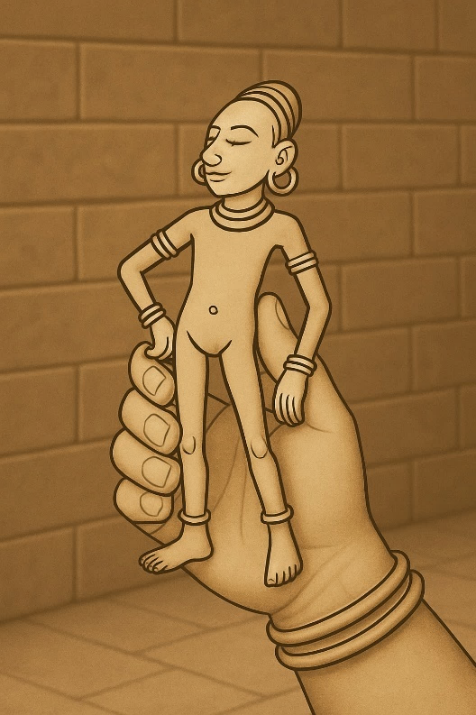
It was of a young, slender girl, with her hair tied up into a bun, one hand on her hip, bangles on the other all the way from wrist to elbow. She was confident and defiant. Yet serene and at peace.
Ebilgames passed the cotton cloth, seeing Ezra’s eyes well up.
“Do you like your sculpture, Ezra?”
“Yes, very much. But not this name of mine that you all keep calling me,” she said.
“What would you like to be called then?” Helup asked her.
“I always knew what I would like for my name,” she said, standing with her head held high, as confident and defiant as her sculpture.
“I want to be called Hezra.”
Helup held her and kissed her forehead. “Hezra! A child of Henanna, just as you are.”
CHAPTER THREE
Of Mysteries and Uncertainties
The nights were cold in Kukkutur even in the peak of summer. The red bricks would emanate heat stored from the day and keep the temperature from falling. Yet the people still wanted to get to bed early and cozy up in their blankets of wool or jute, as one’s privilege permits.
Which is why it was brave of Etal and Ehrun to sneak out that night. The adrenaline kept them warm as their hearts raced with every step they took gingerly toward Dyaus’s house.
“I hope they are asleep by now,” Etal whispered.
“What if the aswa is also asleep?” Ehrun wondered.
They both had spent much of the summer wondering about the aswa. They believed the Hurrians were lying. Etal had tried to sniff the gossip out of the aresis during his evening walks. Ehrun kept prodding Endra and Emisha during their games. All to no avail.
They both knew that those who hate the followers of Henanna couldn’t possess Otraikompan. Yet they wanted to see it with their own eyes. They wanted to confirm that the aswa was not Otraikompan.
They would even peek from their terrace at night. Dyaus’s house wasn’t far from theirs, and they could get a narrow view of the courtyard. They tried peeking night after night. The aswa was never to be seen.
“I am sure it is their cow!” Etal said as they marched forward stealthily. “And cows don’t sleep this early.”
“Maybe we shouldn’t have picked a full-moon night,” Ehrun grunted. The streets were empty except for them and their long shadows.
“Shhhh.” Etal’s face brightened up. “You hear that?”
They heard faint whimpers from an animal inside.
“Otraikompan wouldn’t whimper! That’s a cow!” The old man exclaimed.
“Let’s go into the courtyard now.” Ehrun was getting impatient, pointing to the street leading to the entrance of the house.
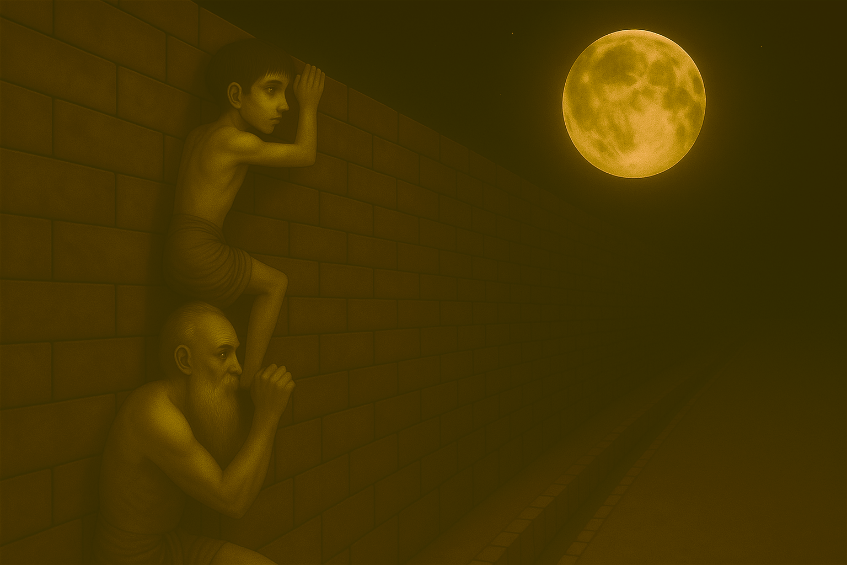
“And wake them all up?” Etal dismissed him. “We should climb the wall to peek in.”
Ehrun looked up at the tall wall in front of them and counted the bricks on his fingers—counting to twelve at a time on his left hand, folding one finger on his right, repeating it until he finished counting the bricks.
“Those are fifty-two bricks. That is as tall as thirteen bricks by length.
“Appappa, you are as tall as six bricks by length—”
“And one by breadth,” Etal interrupted as he stopped crouching and stood taller.
“I’m just five bricks by length,” Ehrun said. “We won’t make it over the wall even if I stand on your head!”
“All those acrobatics your appa teaches you to jump over a bull, but you can’t make a leap off my shoulders?” Etal said before he mimed to Ehrun to come running and jump off his shoulders and hang on to the wall.
“Your old back will break, appappa,” Ehrun whispered.
“I won the kaalai-taluvu during my time. I have been doing it even before your appa was born! And I’ve rowed our boats up Endusa every year against the river streams,” Etal wasn’t happy being called old. “My hairs have greyed but not my flesh and bones. Not these shoulders. Now hurry up!”
Ehrun hesitantly went back a few steps as Etal crouched. He closed his eyes and remembered the tricks Ebapu taught him.
‘“Focus on one foot at a time. Lock your eyes on the target. Keep increasing the pace and the length of your stride as you run forward. And when it is close enough, leap with your left foot on the floor and land on the bull with your right foot.”’
‘“How will I know when it is close enough, appa?”’
‘“You will know it instinctively. You will see it in the eyes of the bull too.”’
Ehrun picked pace as he came running, locking his eyes with Etal, and leaped onto his back just as the old man lunged up, sending the boy flying up to the wall to catch its top.
Just about.
“Appappa, push! Push!” Ehrun squealed softly as he hung on the wall with his fingertips. Etal pushed him up by his feet as Ehrun lifted his torso over the wall, peeking into the courtyard. His legs hung out into the street.
The courtyard was empty. A fire pit at its center was still emanating faint dark fumes from the burned-out wood.
“Where’s Dyaus?” Ehrun wondered. Elders in the highland usually pulled out their jute beds in the courtyard.
“You can’t sleep out here in the summer with all the heat from that firewood anyway,” he said to himself.
“Neighhh!” A squeaky whine arose from the corner.
Ehrun pulled himself up farther to take a look. There was no animal in sight.
“Neighhh!” The whine got sharper. He heard hooves stomping on the ground of what looked like a cowshed.
“Cows don’t do that!” he wondered. He leaned farther and got a quick glance of that animal’s back.
It had a long bushy tail and stood taller than the tallest bull in Kukkutur.
“That’s surely not a cow,” he murmured as his hands started to get tired.
“What is happening there? Did you see it?” Etal whispered loudly from below.
“It is not a cow!”
“Then what is it?”
“I don’t know!” Ehrun grunted. He was about to give up as his hands trembled from all the strain. The animal must have heard the grunts. It moved just enough for the moon to cast its shadow far into the courtyard. Ehrun’s whole body froze at the sight ahead of him.
The shadow on the courtyard formed a surreal silhouette. Long snout, long legs, and a long bushy tail. It was nothing like he had imagined in his wildest dreams.
Except for that horn. It was just as he had seen in the skies. It was just the thing he had hoped not to see on the aswa.
“I’m coming down!” he said with a shaky voice as he landed his foot on Etal’s shoulders.
Etal slowly crouched, letting Ehrun scale the wall down. It was almost perfect—until it wasn’t.
The old man’s shoulders gave out, his feet slipped, and he fell onto the drain on his back.
“Arghh.” He groaned as Ehrun helped him get up.
“Are you OK?” Ehrun asked.
“I’m fine. It’s just these rickety bricks.” Etal kicked away a piece of brick. He was dismissive of the fragility of his old age.
“So, you really didn’t see anything?” he asked Ehrun.
“No, just those weird noises.” Ehrun looked down and walked ahead.
“It is a cow!” Etal said as he caught up with Ehrun and put his hands over his shoulders.
“It must be underfed and hungry,” he told him as they walked back home.
Etal struggled to fall asleep that night. He tossed and turned to find reprieve from his nagging backpain. Ehrun couldn’t sleep either. The shadow of the aswa kept flashing in front of his eyes.
They were lying down on Etal’s bed in the courtyard, looking up at the sky. Otraikompan wasn’t in sight until much later, and they had both fallen asleep by then.
“It was Emisha. I saw him! I saw that little pig run away!” Helup screamed as she stormed into the courtyard, waking up Etal and Ehrun, who were tired from their adventure the previous night.
Ebapu walked in right behind her. “We didn’t expect them to agree to this. We knew they were going to react.”
“React like this, appa?” Helup turned back and stared at her father. Etal and Ehrun rubbed their eyes open to the ghastly scene.
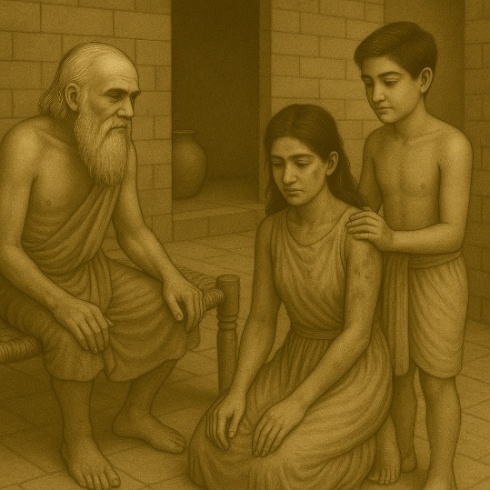
Helup was covered in cow dung—her sari, her hair, her feet. Hethussu came running from the kitchen.
“Who did this? Ebapu, where were you—” She stopped in her tracks as she saw Ebapu covered in dung too and his forehead bleeding.
“Can someone tell me what happened?” Etal sprung up in anger but sat back immediately. The stiff back had only gotten worse overnight.
Hethussu brought a jar of water and started cleaning Ebapu’s forehead as Helup sat down in the courtyard.
“What happened, Helup? Where were you both?” Ehrun came and sat next to his sister. Enbu sensed trouble and walked around the courtyard anxiously.
“I went to the veliyas early this morning just as I promised Ebilgames. Appa wanted to come with me to serve the veliyas himself. Ebilgames and Hezra joined along the way.
“Did those veliyas do this to you?!” Etal was flustered.
Helup gave a death stare to Etal. “Appappa, you say that Kukkutur doesn’t have the abundance it had when you were growing up. You never told us about the veliyas! Forget abundance, they have nothing!”
Etal tried to look away from Helup.
“I met their children. Those poor children living outside of our sight!” Helup said, keeping her eyes locked on Etal before turning to her brother.
“Ehrun, they are smaller than Essarukin. Their eyes were swollen and their skin stuck to their bones. It was heartbreaking to see!
“Even so, they were beaming with happiness seeing us go into their houses to meet them. I sat down with them immediately to start our classes. Appa and Ebilgames worked with them to clean and fix their streets and homes.”
“Why would you clean the veliyas’ streets?” Etal said unabashedly. “That is their one job!”
“If they can clean our streets, I can clean theirs too,” Ebapu mumbled as he rushed into the bathroom to clean himself.
“Those children were afraid to learn from us. They were afraid that those in the highland would reprimand them for learning,” Helup continued. “Can you imagine living with that fear, Ehrun?”
Ehrun couldn’t. He had a bigger fear to live with—the one he encountered the previous night.
“Hezra helped ease them into interacting with us,” she continued. “I taught them a bit of counting, the story about the crow and a jar of water… everything I taught you when you were smaller.
“As appa and I left, the children came running and giggling behind us all the way to the city gates. Ebilgames stayed back to teach craftmaking to the older children.
“As we approached the steps to the highland, we could hear those Hurrian boys heckling us from the top. We ignored them and kept climbing up. Appa was tired, and I held his hands as we walked up.
“And out of nowhere a pile of dung came and fell in front of me. Before I could even look up, there was dung flying at us from above in all directions. I covered my head and could barely look up.
“Appa held my hands, and we continued climbing up the stairs, and that’s when the atrocity stopped.” Helup wiped dirt off her forehead.
“I ran up to get a hold of them, but they were already fleeing in all directions, she continued, “but I did catch a good glimpse of one of them. That oily, bald pig with the tiny ponytail! I can pick him out of a crowd!
“I turned back to tell appa and that’s when I saw the wound on his forehead,” she said. “There must have been a stone in one!”
“That’s it! I have had enough! They have now started attacking our families!” Etal finally managed to get up and stand straight. “I am going to call for a city meeting with the pujaras.”
“They won’t stand by you,” Ebapu remarked as he came out of the bath, drying the folds of his ears with his lungi lifted from one corner.
“With all their differences, keeping the veliyas uneducated and away from us is one thing the aresis and pujaras agree on.”
“But I am not going to ask them to stop doing that! They can’t hurt my family. I want to make—”
“We can’t change them by force,” Ebapu interrupted him.
“Paapa, we will just carry another sari and lungi with us from tomorrow.” He comforted Helup. “Please go clean yourself now!”
Helup got up to leave but stopped and turned back to look at Etal.
“You don’t need to speak for me,” she asserted. “I agree with appa. We will just keep doing what is right.”
“No, I have to take this to the city hall,” Etal was adamant. “Ehrun, are you coming with me?”
“Yes! Emisha must be punished! He is dangerous—”
Ehrun could barely finish his outburst before he saw Ebapu staring him down.
“Your sister can speak for herself,” Ebapu said.
“Yes, appa. But you know they don’t let women in the city hall anymore,” he said as he walked ahead with Etal. He didn’t want to miss the opportunity to teach Emisha a lesson.
As he followed Etal out of the courtyard, he caught a glimpse of Helup from the corner of his eyes. She was shaking her head in disapproval.
He knew that a difficult conversation was waiting to be had upon their return.
Etal and Ehrun were making their way to the city hall through the narrow streets, with Enbu leading the way. A crowd of aresis went weaving around them, laughing boisterously. Their laughs scared Enbu, who moved to the side.
“The sun is on top of their heads and they are still not in the city hall!” Etal murmured. “They keep spending their nights intoxicated with their haoma and call themselves our leaders!”
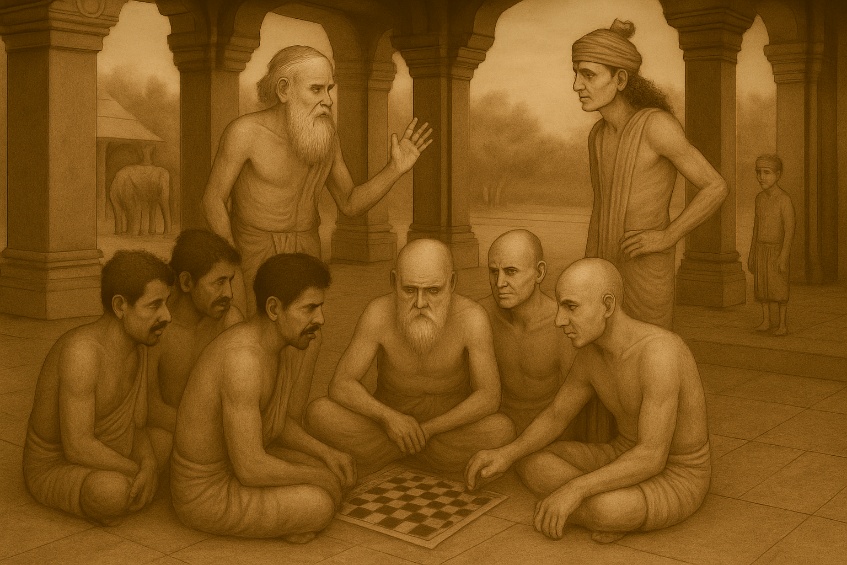
As they entered the hall, Ehrun turned back to make sure Enbu was right behind. The pujaras were already sitting in a circle on a raised platform, playing pakitai with the aresis.
The pujaras with their dark skin and aresis with their pale skin contrasted just like the white and black pieces on the checkerboard.
“Etal, we haven’t seen you in a while!” said a pujara. “And you chose the wrong day! We have no complaints to discuss today.”
“Yet!” Etal shouted. “Did you hear what their children did? Today their mischiefs reached our doorsteps.”
“It is not a mischief. It is a crime!” Ehrun added.
“Don’t speak when your matrmaha38 is speaking, child. We will hear you after,” an aresi said. They despised children raising their voices in front of the elders.
Etal signaled Ehrun to sit down on the steps before walking right up to the platform. He stood in front of the crowd and scanned every face, looking each of them in the eye as he narrated the ordeal that Ebapu and Helup went through.
“On our women!” His voice filled with disgust. “The attacks have now started on our women!”
“But, Etal, why did she go out to the lands of the veliyas?” a pujara asked.
“Yes, why did she? Your women are bringing us shame by stepping out and doing as they wish,” an aresi joined in. “Yesterday I saw his daughter walking around with the vanijas from the west. She hadn’t covered her shoulder, let alone her head!”
“Maybe this time she will bring home a vanija from the west to replace her vanija from the lowland,” another aresi said. “I hear he is not much of a man anyway.”
The whole circle of aresis burst out in laughter.
“Enough!” Etal reprimanded them with his fingers wagging. He could see Ehrun fuming in the background, pacing back and forth on the steps.
Etal moved closer to the pujaras. “You ought to know better. Is this how we have treated our women? Is this what all our worship of Henanna was for?”
“They made Hedumbi and so many of your daughters and the women and others you lived with leave Kukkutur,” he continued. “What more must happen before you raise your voices?”
“Well, what evidence do you have that their children did it?” a pujara asked.
“My sister saw Emisha. She got a good glimpse of him struggling to run up the hills,” Ehrun interjected.
“You will only speak when spoken to, Ehrun,” an aresi commanded him.
“What evidence do you need? Helup saw him,” Etal said.
“That’s just the word of one child against another—”
Before the aresi could finish his argument, a silhouette rose from behind Etal, and the whole hall fell silent.
Etal turned around. “Dyaus?”
The man walked ahead and towered over Etal, standing close to seven bricks by length39. The sunlight that crept from under the beams of the hall cast a spotlight on him as he walked forward to the center of the city hall.
He wore leather footwear unlike the jute sandals that men wore in Kukkutur. His lungi was different. Instead of tying around one’s hip, it was held together by an ornate belt. Frills of the lungi were flowing down from his navel. As the light reached his torso, it almost blinded Ehrun as it reflected off his thick golden necklace. His face shone brighter in the sun, accentuating his blue eyes. His hair was tucked in a tall headgear—which surely added a brick’s breadth to his height—with stray hairs flowing out in the wind.
“Etal! How many times have I called on you? And here you are finally,” Dyaus said.
“I didn’t accept your invitation to your house, but I never disagreed to meeting you,” Etal scorned as he looked away.
Ehrun was perplexed. Going to Dyaus’s house was exactly what they did last night. Uninvited.
“We need to work together for Kukkutur. Herahuati must flow again. We have all these pujaras here but none like you who can lead the clan,” Dyaus said.
Etal found it difficult to hide how pleased he was to have his ego massaged. Leading Kukkutur was the calling that his people were born into and what influenced every decision of his life. Now, here was a man, a leader himself, bestowing that power on him.
“What do you mean Herahuati has to flow again?” he said as he managed to hide his smile in a manner that he always did—pretending to wipe the sweat of his lips with the corner of his lungi.
“It is the blessing of Henanna and at the time of her choosing. We can only pray,” he mumbled through the wiping.
“Let’s speak in private.” Dyaus put his hands over Etal’s shoulders and pointed toward the pond.
Ehrun watched in awe and fear as Etal and Dyaus walked past him. He had always looked up to Etal as the most imposing, charismatic, and powerful of all the people he knew. Now, the old man looked like a cow led by its shepherd.
Dyaus stopped, turned around, and looked at Ehrun.
“You’re Hethussu’s child, right?” He looked him up and down. “I have heard a lot about you from Endra.”
Ehrun looked down in fear, wondering what Endra must have told him.
“Did he tell him about how my family hates the Hurrians? Did he tell him that he tricked me into going across Endusa? Does he think I am an imbecile?” he wondered.
As he looked up, Etal and Dyaus had walked over to the other edge of the pond. Dyaus still had his hand over Etal’s shoulder.
“We need to seek the waters of our rivers. And we will start with Herahuati,” Dyaus reiterated.
“How do you suppose we do that?” Etal asked.
“I intend on sending the aresis to do a yasna40 at the foothills of Meru41. I am confident that—”
“A yasna? You think Henanna will be pleased by a yasna?”
Dyaus wasn’t pleased by Etal’s disdain, but he kept his displeasure for another day.
“It is for Egni!” he clarified. “But we need a puja42 as well. I want your help in convincing the pujaras to take the trip along with the aresis. Can you convince them? I believe you are the only one who can.”
“I can do that!” Etal exclaimed. Dyaus’s compliments were surely seeking results. “But I have two conditions.”
“What are they?”
“One, you need to punish Emisha for what he did to my family.”
“Hmmm, and the other?” Dyaus asked as he raised his eyebrows.
“And I want Ehrun to lead the pujaras. He is the next generation, after all.”
“I see.” Dyaus smiled. He knew what this meant. Etal wanted to project Ehrun as the leader of Kukkutur.
“I agree with your first condition. We will meet again tomorrow morning to decide on the punishment.
“I agree with your second condition as well. But Ehrun will only lead the pujaras. Endra will lead the aresis.”
Etal nodded his head in agreement as he looked over at Ehrun. The boy stood there unaware of what lay ahead of him.
“Looks like you got what you wanted,” Hethussu said, seeing Etal and Ehrun walk in gleefully.
“Amma, Emisha is going to get punished and I am going to Meru,” Ehrun screamed as Enbu circled around him, wagging his tail.
“You are going where?” Hethussu was confounded. Helup and Ebapu rushed out from the kitchen.
Etal sat the family down and narrated the happenings at the city hall and his agreement with Dyaus.
“Now, tell me how you would like Emisha to be punished?” the old man asked Helup.
“I think you forget. I didn’t want you to punish him. I can very well handle—”
“Helup, maybe this is a way for Emisha to learn to be a better person,” Ebapu interrupted. “What if his punishment was to serve the veliyas?”
“I like that!” Helup was elated. She smiled for the first time since she returned home that dreadful morning. “He has to live with them and experience firsthand what the life of a veliya is like!”
“Great! There you have it.” Ehrun was jubilant. He didn’t even try to hide his delight. “And he has to stay out there with them until after the next two andu!”
He was indeed happy to see Emisha get what he deserved, but he was happier to know that he avoided the tough conversation with Helup for disobeying her wishes. She seemed content with the outcome.
“Wait, but how did you decide to send Ehrun for the puja?” Hethussu brought the conversation back to her concern. “Traveling all the way to Meru? It takes 12 days and 12 nights through the forests and mountains. And all the wild animals! This cannot be!”
“Yes, he is too young. We wait for our children to see fourteen andus before we even send them to the west—that too a travel in the comfort of ships and caravans,” Ebapu said. “And here you are suggesting that we send him through the forests at this age?”
“I understand. And I am concerned about his safety too,” Etal said softly. “But we have a bigger task at hand. We cannot leave our land to the Hurrians. Would you want anyone else to face what you did, Helup? Would we want any more of us to leave Kukkutur like Hedumbi did?
“We need a pujara leading us. There is no pujara out there thinking about the future. They are happy whiling time with the aresis. We need a leader. We need to show them that we have a leader. And I see that in Ehrun—”
Etal noticed Helup’s face sullen. This conversation wasn’t new to her or any of the other women in Kukkutur. Ever since they were made to cede control of the city hall, they were increasingly used to having the men in their lives make decisions and lead the people.
“Helup, I am not passing over you. I understand you have it in you to lead us. You are older too.” Etal said. “But the times have changed with these Hurrians amongst us. We need a leader who is acceptable to the aresis as well.”
Helup smirked at the justification. It was political practicality being espoused at the cost of fairness.
This again wasn’t new. She was, after all, witness to the events leading up to Hedumbi and the other women leaving Kukkutur.
“She is no less a leader for all the work she is doing with the veliyas,” Ebapu tried to comfort her as Ehrun sat next to her with his head on her shoulder.
“Appappa, you must promise that he will come back home safe,” Helup said, embracing her little brother.
“I have never given a false promise to my children. I could have said Herahuati will flow again to make you happy. I didn’t. I don’t even believe Herahuati will flow again after this puja. We will never have that prosperity for as long as the Hurrians live amongst us.
“But his return,” he said, looking at Ehrun. “That I promise. It is the will of Henanna to have him lead Kukkutur. I will offer a meal to her every day that he is away—”
“Helup, Ebapu, what happened? What happened?” a man ran into the courtyard with his face and head covered in a cloth.
“Ebilgames?” Etal asked.
“I came as soon as I heard,” he said. “But the sun had set, and I would be in trouble if they saw me in the highland at this time.
“I covered myself and walked stealthily through the crowds,” he continued. “Don’t worry. No one noticed me!”
“I am sure everyone did!” Ebapu said. “No amount of cloth can cover your beard. You almost swept our courtyard with it on your way in.”
Hethussu and Helup broke out in laughter.
“Helup, are you OK?” Ebilgames came close to her and looked her in the eye.
“I am sorry I put you through this,” he said as he held her hand. “I knew they wouldn’t remain silent, but I never imagined they would react this badly.”
Helup was not one to hold her words back. But this once, she struggled to speak.
“She wasn’t hurt. She is a strong woman,” Hethussu said. “And that boy will get his punishment tomorrow!”
“If there is anything I can do,” Ebilgames said, still holding her hands. “I feel guilty that you had to—”
“Well, there is something you could do for us,” Etal said, holding Ehrun close to him. “I want you to go with him and the pujaras to Meru for a puja. I want you to bring him back safe.”
“Of course, I will do that. I will protect him with my life!” Ebilgames proclaimed. “But… would the aresis allow me to go along with them?”
“I will take care of that,” Etal said.
“Then I will take your leave.” Ebilgames finally let go of Helup’s hands as he turned around.
“No, it wouldn’t be safe for you to go back at this time. What if an aresi sees you?” Helup stepped in front him.
“With all that hair and your beard, they will notice you from a distance,” she chuckled as she looked him up and down.
“Why don’t you stay with us for dinner? We have enough for you too. And…,” she continued, “... I think you should sleep here tonight and leave in the morning.”
Ebilgames agreed with a mousy nod— a dissonant sight for a man of his burly physique.
Etal had an uncomfortable sense of déjà vu seeing what had just transpired: a woman in his house inviting a man from the lowland. He held back his thoughts as he walked out into the streets for his evening routine—gossiping with the pujaras.
The highland awoke early the next morning. Crowds of aresis and pujaras briskly walked along the streets like ants in disarray. The rumors had spread about Emisha’s impending punishment and Ehrun and Endra’s travel to the foothills of Meru.
Ehrun and Etal were early to the city hall and seated on the platform. Dyaus and Endra joined shortly after and sat across from them. The men trickling in sat around the platform in circles. Sitting cross-legged, they fought for space to get close to the action, their knees and elbows pushing against those next to them, causing grunts and murmurs.
“Silence!” Dyaus commanded. “We will start with Emisha’s punishment.”
He scanned around as Emisha’s shaved head slowly arose from the crowd. He stood calm and composed, as though he had no fear for his imminent fate.
“I heard that you want him to be cast outside Kukkutur until the end of the second andu from now,” Dyaus looked at Etal who nodded in agreement.
“And so shall it be!” he continued, looking at Emisha. They exchanged a faint smile. Endra sniggered.
“Appappa, there’s something wrong,” Ehrun whispered into Etal’s ear. “They’ve hatched some covert plan.”
“Not just anywhere outside Kukkutur,” Etal clarified. “He will stay with the veliyas. And he will serve them and their needs all day under the supervision of Ebapu.”
“He can’t live with those mlecchas and come back as one of us,” an aresi said. “He will be polluted.”
“Well, don’t you do a yasna to convert people into aresis?” Etal taunted. “Just light a fire and wash away his impurity when he is back.”
The aresis looked at each other and murmured, scrambling to find a retort.
“Can I stay with the udavas?” Emisha asked.
“It is not udava. It is uzhava!” Ehrun laughed. “And why? So that you can eat all the food they produce?”
Emisha stood there fuming, sweating along the folds of his body.
“OK, so be it then. He will stay with the veliyas,” Dyaus commanded. “Emisha, you can sit down now.”
Emisha sat down in anger. Endra’s face had fallen. Dyaus wasn’t happy with the outcome either, but he needed to move on.
“We need to get to the more important discussion,” he said. “Etal and I have decided to send five of our pujaras and five of our aresis to the foothills of Meru. Ehrun and Endra will join them.
“They will sail along Herahuati, rowing against the shallow stream, until they reach the rapids. They shall then walk along the river all the way to their destination, keeping a safe distance from the riverbanks and the makaras. We will give them spears and axes to ward off any bandits or wild tigers.
“Once they reach there, they will do their puja and yasna. Those of us here in Kukkutur will also conduct yasnas and pujas every day for their safe journey back and will feast in abundance upon their return.
“Herahuati will return to her abundance too,” Dyaus proclaimed as he looked toward Etal.
“And one more thing,” Etal said. “Ebilgames will accompany them on this travel—”
“What? He is a—” an aresi interrupted.
“—mleccha?” Etal asked. “He will pollute you? If you don’t make it back alive, what will you do with all your purity? Have you looked at your scrawny selves? Do you think you can protect yourself, let alone these two?” he said, pointing at Ehrun and Endra.
“Ebilgames has traveled to the west and the north—through desert and mountains; on ships, caravans, and on foot. He has faced hurdles you can’t possibly imagine—”
“He will escort all of you!” Dyaus joined in agreement. After all, he wanted his son to be protected too.
“Now, Ehrun and Endra, rise up and bow down to your elders,” Dyaus said.
Endra did so promptly. Ehrun looked at Endra and mimicked the action.
“The travel should start tomorrow so you have a full moon to guide you on the first night of your journey,” Etal said as the pujaras and aresis nodded in agreement.
“And you will have a full moon on one of the last nights43 of your return home,” Dyaus added.
Ehrun and Endra turned toward each other with faces bereft of emotions.
What emotion could their faces even express? They could glee with excitement at the prospect of the adventure that lay ahead of them. Or they could frown in discontent for being paired together. As passionately as they disliked each other, they knew they must spend every waking breath over the next several days in support of each other.
They were too young to tame those conflicting emotions.